
Grease Pencil Fill as gradient mesh, with independent vertex opacity
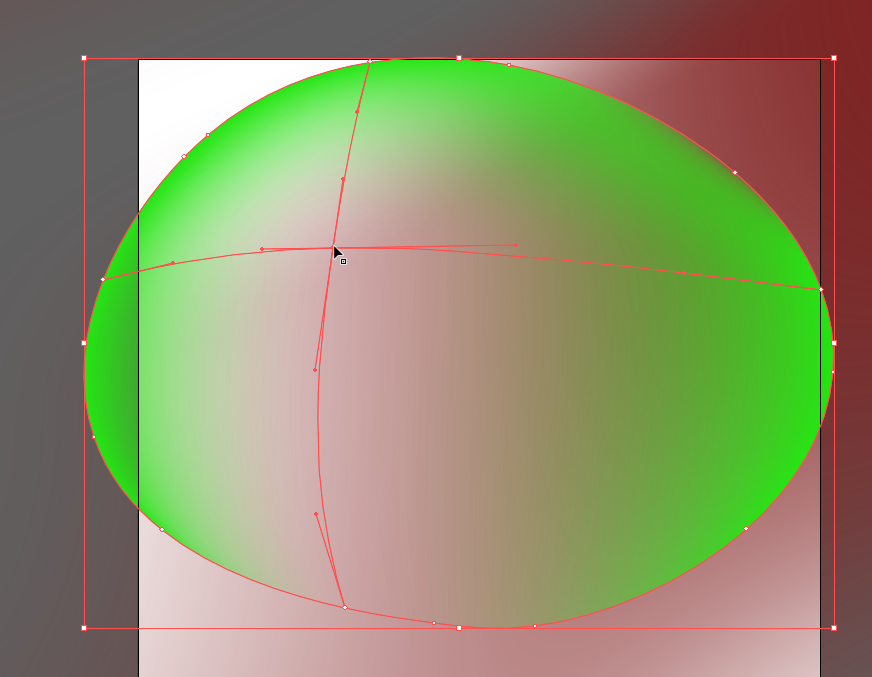
This is a gradient mesh in Illustrator. I've taken the time to add to its grid manually to show the kind of feature that would make it possible to use fills as pseudo gradient meshes.
As you can see, each point of the fill, including inside, can be selected, and their opacity and color, changed individually. In the case of Blender this would be individual vertices.
Here in this case I wanted to show specifically opacity. In Illustrator, I've taken to a habit of using gradient meshes to make detailed shadows.
In the case of Blender, with Grease Pencil, I can foresee this being the best method for making accurate soft to hard shadows for animation, with some masking.
As an example, within Blender, in Grease Pencil, let's say you make a fill, right? Much like how fills don't work very well with vertex color at the moment, just changing transparency for one vertex of a fill would probably not look that great.
So, the idea is, with a knife tool, you could create edges within that fill, from which you could select vertices to make them less or more opaque, as you could with the outside edge.
The ability to then color only a specific vertice you have selected in edit mode, on top of opacity, could also offer a much greater range of control.
2 Comments
GP != curves
* @ Vyacheslav * I understand that GP isn't nurbs or vectors, I'm not showing this off as a vectors-only implementation.
This could likely be done just as easily with vertices and polygons, as it is done at the moment for grease pencil.
I'm just showing Illustrator, which happens to be vector, as an example of what could be done within the context of grease pencil, regardless of using curves or not.
Grids are reliant on connecting points, not on vectors specifically, and we can already do fills out of vertices, filling most of not all of the requirements for gradient mesh implementation.
I fail to see how opacity couldn't be implemented. It's an integral part of most if not all 2D workflows.
We can already change grease pencil opacity, and we can already change the colors of individual vertices. Add to that opacity, and the ability to add points/grids to fills, and you basically have gradient meshes, with a much easier functionality than in any vector software you could imagine.
I understand that one of the difficulties is that vertices introduce a lot more points than you would have with vectors.
So, here's an idea. Know how ALT+S lets you change thickness based on a selected point, with proportional editing as a falloff?
That, but for transparency/opacity, with the ability to add points/grids inside of fills manually. I think that would make for everything that you could want to do with a gradient mesh/editing colors of vertices individually.