
Improve sculpt remesh handling for non-manifold and holed geometry
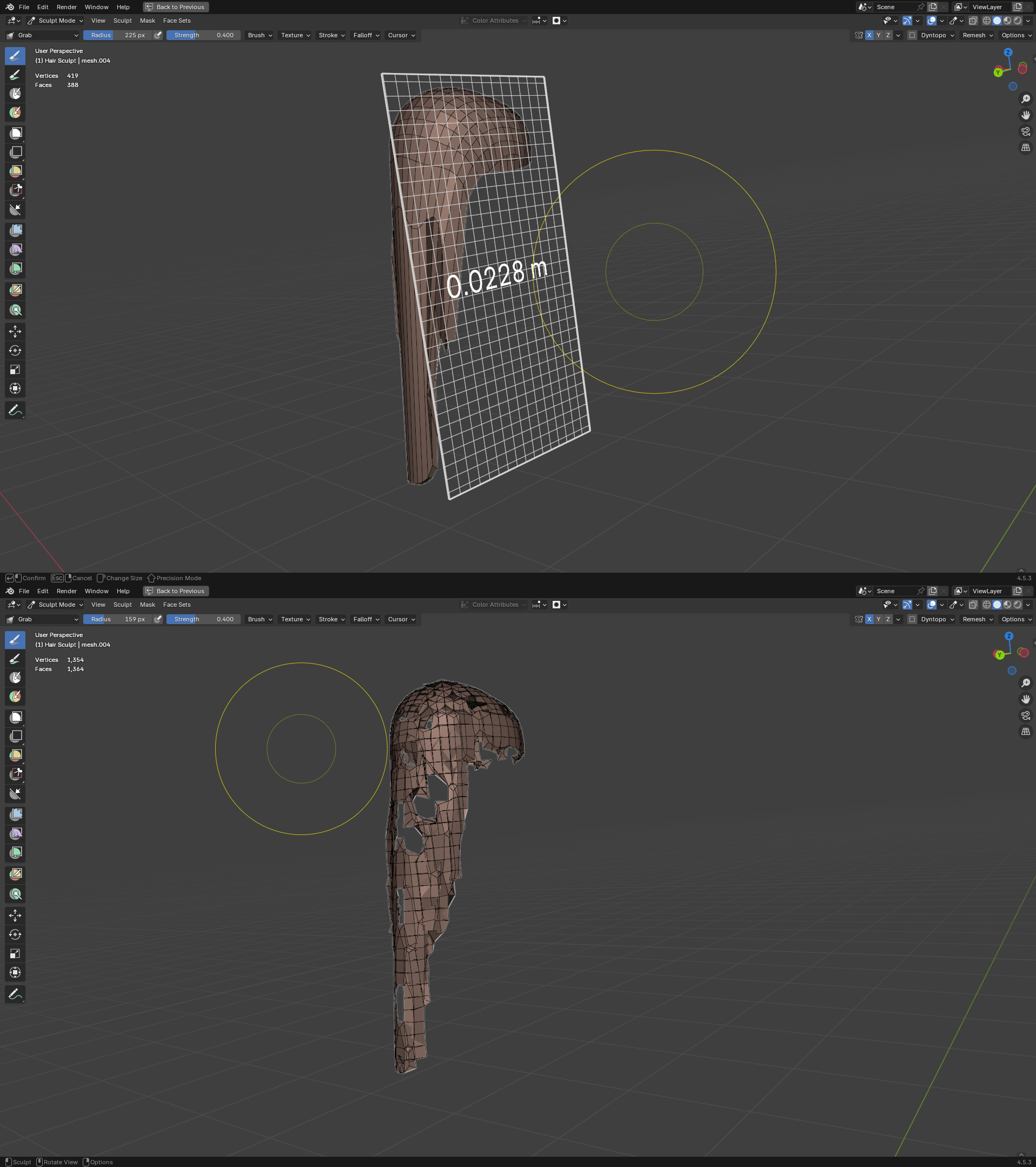
Currently, Blender’s Sculpt Remesh fails when working with thin geometry or meshes containing holes, regardless of their size. This significantly limits the workflow when sculpting, especially with scanned or imported models where hidden holes or non-manifold edges are common.
The current workarounds are:
-
Manually locating and fixing hidden holes, which is often time-consuming and interrupts the sculpting process.
-
Applying a Solidify Modifier to give thickness to the mesh, which may work in some cases but is unreliable and introduces unnecessary geometry.
I would like to propose a refinement to the Sculpt Remesh algorithm so it can better handle small holes and thin geometry. Even a partial improvement in this area would reduce the need for disruptive cleanup steps and make sculpting workflows smoother, particularly for artists working with complex meshes.
Such an enhancement would bring Sculpt Remesh closer to the robustness of voxel remeshing tools found in other sculpting applications, making Blender more accessible and efficient for digital sculptors.
1 Comment
Disclaimer : I am not a developer, so parts of this response may be inaccurate, feel free to correct me on anything I miss
Fixing this would be pretty tough to do because Blender uses an external library called OpenVDB to do voxel remeshing. The way OpenVDB remesh works is by converting your mesh to a volumetric grid of voxels, and then back into a mesh. To convert to a volume, OpenVDB needs to know where the inside of your object is, and where the outside is, so if there are holes in the surface, its impossible to accurately tell what is inside, and what is out, thereby invalidating any volumetric representation of that object.
This is also related to why thin objects and planes don't remesh properly. To calculate the voxel grid that it uses, OpenVDB finds how much of the object is inside each cell. In the case of an infinitely thin plane, the space it takes up inside a cube will always be infinitely small, which makes that voxel empty. Thin, but still 3d objects will be affected similarly because they don't take up enough volume to be registered.