
String Data Type for Named Attribute Node
For example here is a BMesh with 2 string layers (labels read from a CSV file). The strings are not shown in the spreadsheet and can not be used in GeoNodes.
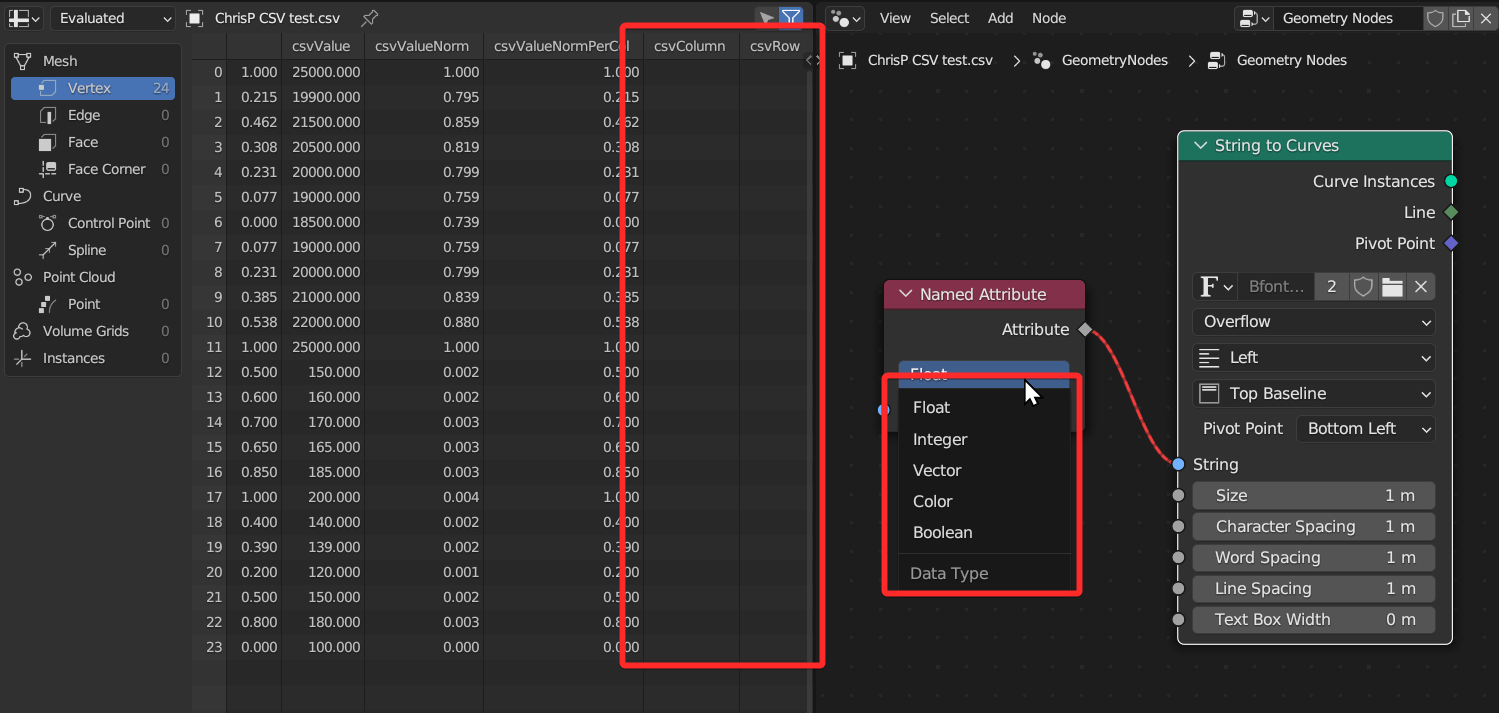
Can someone with deeper knowledge of the topic enlighten us if this can / will be possible?
It would seem that - since GeoNodes already has a String datatype and utility nodes like Join Strings, Value to String, ... adding the String data type to the Named Attribute node would not be hard to do (?)
8 Comments
My use case: I want to draw a molecule structure. First I read the structure with position and the name of the element for each atom. Then, I draw a sphere for each atom, but the size and color of the sphere are based on the name of the element. Therefore, it would be very useful to have the name (string) stored as the attribute in the point domain. It would be also very useful, if we could compare the string fields using the
Comparenode, which AFAIK is not possible for the moment.Another use case: I want to make a timeline of years. Would be nice to be able to output "x" position into strings so I can make incrementing increasing years.
I was looking to do the same thing. Want to animate a chart of the nuclides. There are over 3500 nuclides with about 118 element names (labels), and I'd like to procedurally label them. Each label would need to go to a specific proton/neutron configuration.
Creating word clouds would be another use case.
Can you give a use case example please?
there's very little string support in geo nodes so far, but what about reading map data from a CSV and using the strings to generate labels to show where locations are?
In fact, I already have all of you with your examples here, it will be much more productive: String attribute topic on devtalk
How would you read e.g. row/column labels of a CSV file and store/display them alongside the values? This is what I made years ago using Animation Nodes: imgur.com/MOkkyp2 (see labels)
Simply outputting large text as a bunch of strings and converting them as instances is already possible. Again, just a specific importer is a bad task. Give a more natural example.