
Nodes (GN) : Isotropic remesher
Introduce an Isotropic Remesher Node in Geometry Nodes to perform uniform or adaptive remeshing directly in the procedural workflow. The node creates even triangles and preserves features for better simulation, sculpting, and modelling.
Description
The node generates high-quality meshes with regular triangles, either uniform or adaptive in size.
This helps maintain consistent topology and stable simulations.
Node Inputs
- Geometry --> Input mesh
- Target Edge Length --> Average triangle size
- Adaptivity Factor --> Adjust edge size based on curvature or attributes
- Boundary Preservation --> Control border constraints
- Iterations --> Number of remeshing steps (default: 5)
Node Outputs
- Mesh --> Mesh with uniform triangle distribution or adaptive (Choosed by the user)
Modes
- Fixed Mode --> Uniform triangles
- Adaptive Mode --> Triangle density changes based on curvature or attributes
Benefits
- Uniform triangles improve deformation and simulation stability
- Better sculpting, shading, and baking results
- Fully procedural, no external tools needed
- Supports automatic LOD generation
- Non-destructive, node-based alternative to external remeshers
Why Geometry Nodes
Allows real-time procedural remeshing in node graphs.
Fits Blender's non-destructive workflow and is useful for environments, characters, and simulation-ready assets.
Precise way to implements it and knowing how it works are in the PDF in Comments
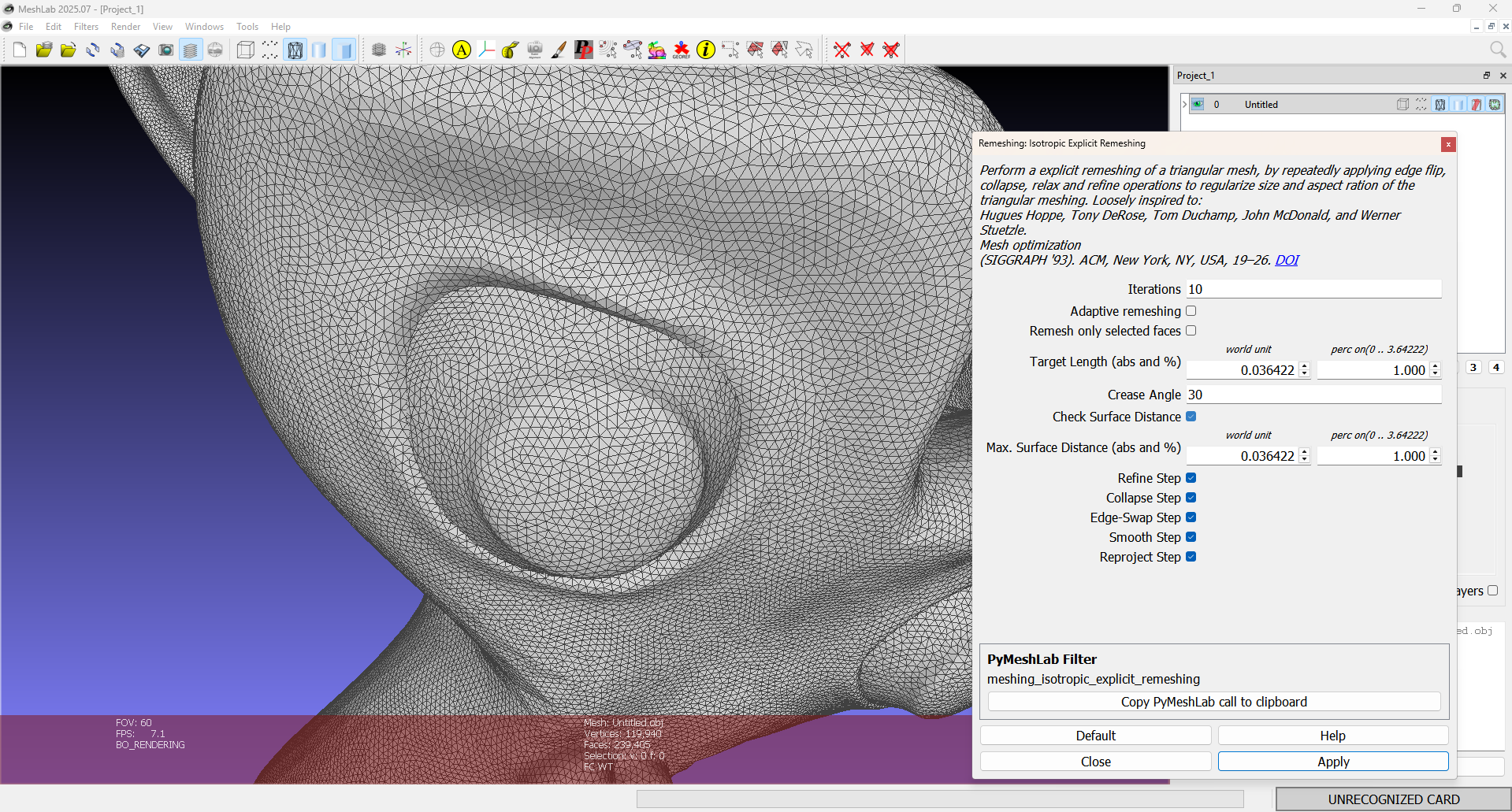
I've been tried some test with Meshlabs and it's very promising !
4 Comments
This is the kind of algorithm you can rebuild in geometry nodes yourself, and I did, but the performances are very bad. A built-in Isotropic remesher like the one we have in Houdini but for Blender would be lovely!
I agree ! But Not really precise WIth standard GN node already present in Blender, a dedicated node could be better job!
couldn't agree more
graphics.stanford.edu/courses/cs468-12-spring/LectureSlides/13_Remeshing1.pdf