
1Big tile renders faster than progressive refine
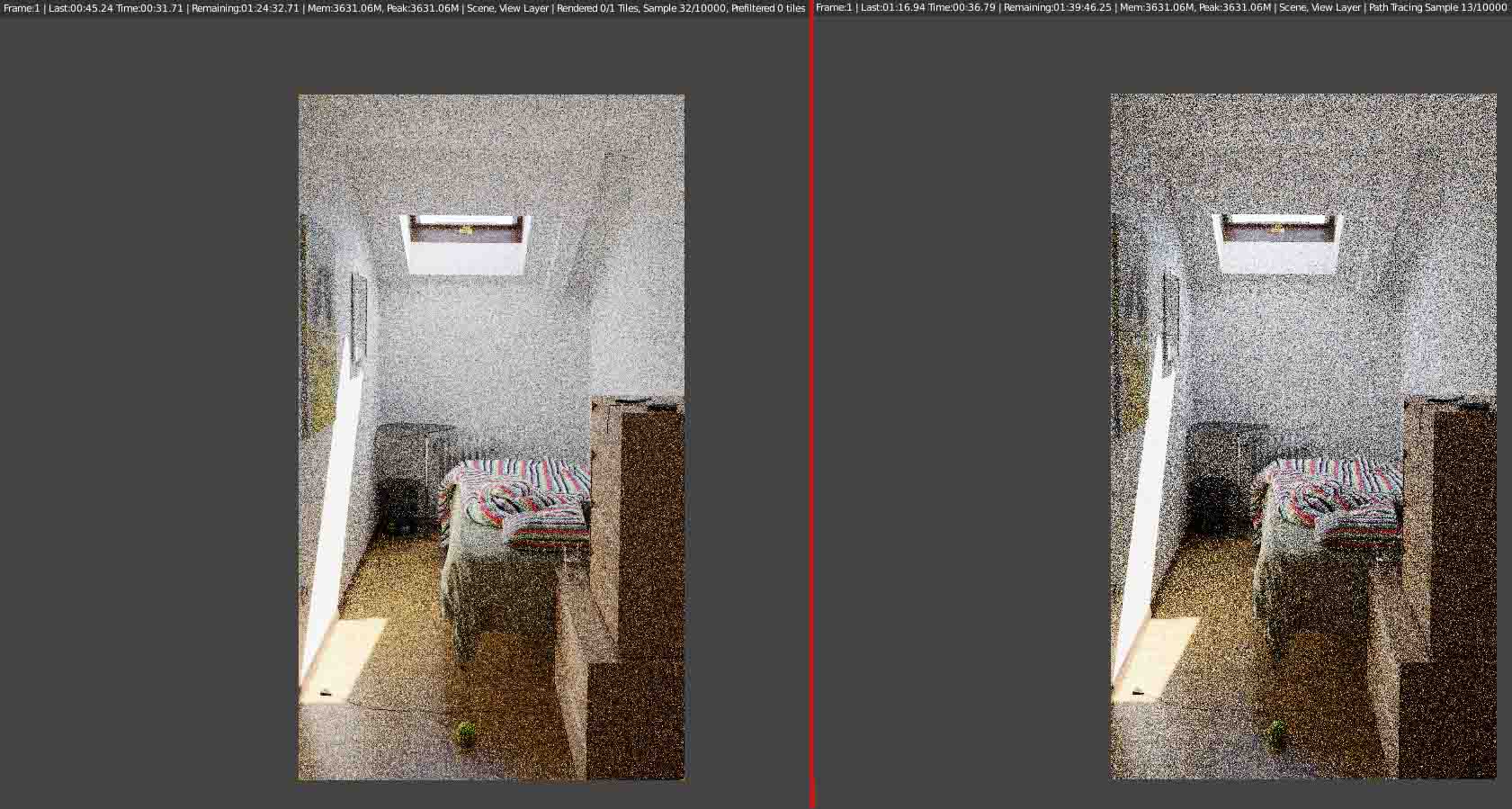
I have a new gpu and i was testing some options in blender with cycles and i saw that rendering a big single tile is faster, not just againts progressive refine, but faster than all other tile sizes when using optix rendering. In this picture, the render on the left is a big tile and the one on the right is progressive refine.
3 Comments
So? What is the proposal?
* @ Lsscpp * Fix the progressive refine
Testing with only one scene and only a dozen samples is... Not reliable at all. Never do render tests like that, it doesn't mean anything.
Here I don't even know what is your point.
That you can render faster with one big tile? Sure, I can too if I fit my render res to it, so what?
That progressive refine is slower? Sure, it's not made to be faster, it's a preview tool.
First things first, the render speed depends on different things. When using a GPU, you will have your best render times using big tiles, but not "any" size. My current GPU renders faster with tiles about 256px², my previous GPU with 128px², some other GPU render faster with 512px², 124px², ... depends your rig. Using "one big tile to render everything" will not give the same result depending your render resolution, your graphics card, the scene content, ... And it doesn't mean mutch. I can assure you that between an instagram poster and a printed wall poster, the "one big tile" won't give the same results.
What progressive refine does is just changing how it queues samples and tiles. Without progressive refine, Blender will load a tile and render it up to the maximum sample you set, then move to the next tile, and so on till the picture is fully rendered. Using progressive refine Blender will load a tile, render one sample, then move to the next tile and repeat this until it has rendered one sample of the entire picture, and then start over to add up the samples to the entire picture until the maximum sample is reached everywhere.
Progressive refine is slower in the long run basically because you spend a lot of time & ressources switching back & forth between different tiles instead of actually rendering the tiles. To put it in another context, it's like if you compared traveling between each country capital in a loop against going to city one then back home, then to city two, then back home, and so on.
TL;DR, I would like to know how you made your tests, because to me it doesn't really look like you made reliable tests.
Here you would need to:
strongest one for your GPU, and then half, then double, then "one big tile the size of my render" if it isn't already reached by the "double tile size" test)
Unless you make several finished renders which represent at the very least the average render and which each put to the test different variables, you won't have any reliable data to make conclusions, hence no reliable conclusion at all.