
Bridge Edge Loops: Unpredictable Curvature and Lack of Directional Control on Zero-Angle (Parallel) Faces
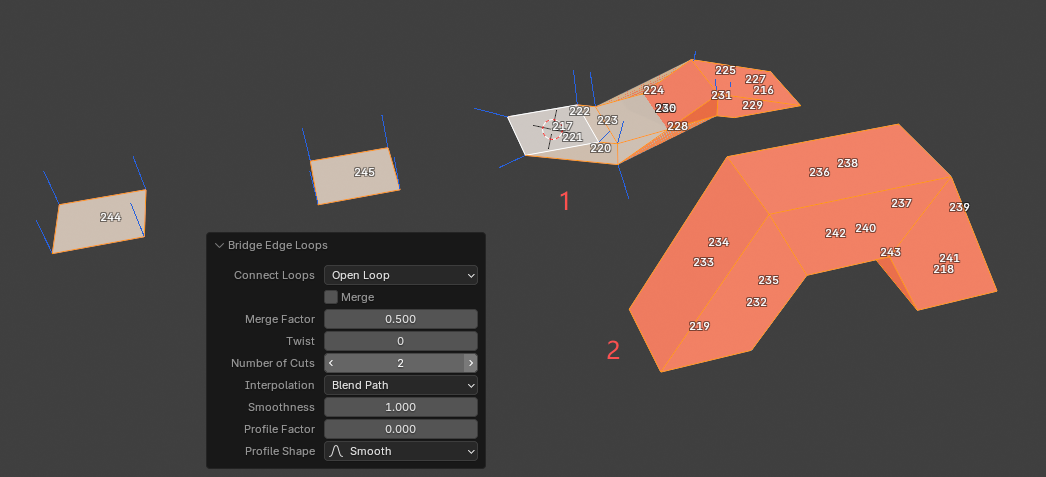 When using the Bridge Edge Loops tool between two perfectly parallel or co-planar edge loops, the resulting curvature direction is highly unpredictable and non-repeatable, making precise modeling difficult for common structures like arches and handles.
- The Observed Phenomenon (不可预测的行为)
I have created two identical pairs of edge loops:
Initial Group (Labeled '1' in the image): When bridging the first loop pair, the resulting connection shows an S-shaped (or double-bend) curvature.
Copied Group (Labeled '2' in the image): When bridging the second loop pair (a direct copy of Group 1), the resulting connection unexpectedly shows a normal N-shaped (single-bend/concave) curvature.
This inconsistent behavior persists regardless of:
Face Orientation: The results are the same whether both faces are correctly oriented (Blue/Outward) or flipped.
Active Selection: The selection order of the vertices/edges does not reliably dictate the outcome.
The different, non-deterministic result for identical input geometry suggests that the algorithm is defaulting to internal, unstable data (like Vertex ID order) when robust geometric guidance (like a non-zero angle) is absent.
- The Problem with the Current Solution (当前方法的局限性)
This ambiguity makes the tool unreliable in common modeling scenarios where precise and consistent curvature is required between parallel surfaces.
- Proposed Solution for Control (建议的解决方案:基于法线控制)
To solve this inherent instability, I propose introducing a secondary factor based on Face Normal Consistency to control the transition direction when the angle is 0 。
Proposal: Implement an option that uses the relationship between the two edge loops' Face Normals to define the curvature sign (S-shape vs. N-shape).
Normal State (User Intention) Proposed Resulting Curvature Consistent Normals (Both Blue/Outward) Forced N-Shape (Convex/Arch) transition. Conflicting Normals (One Blue, One Red/Flipped) Forced S-Shape (Double-Bend) transition.
导出到 Google 表格
This would provide the user with clear, predictable control over the final transition shape simply by using the native Flip Normal tool (Alt + N) to indicate the desired curvature. edited Gemini AI.
1 Comment
I don't know if I agree with the proposed solution, but I agree that Bridge Edge Loops could be greatly improved. Manual control would be helpful, but the algorithm should be biased toward: