Actually there is a reason for the way these are listed.
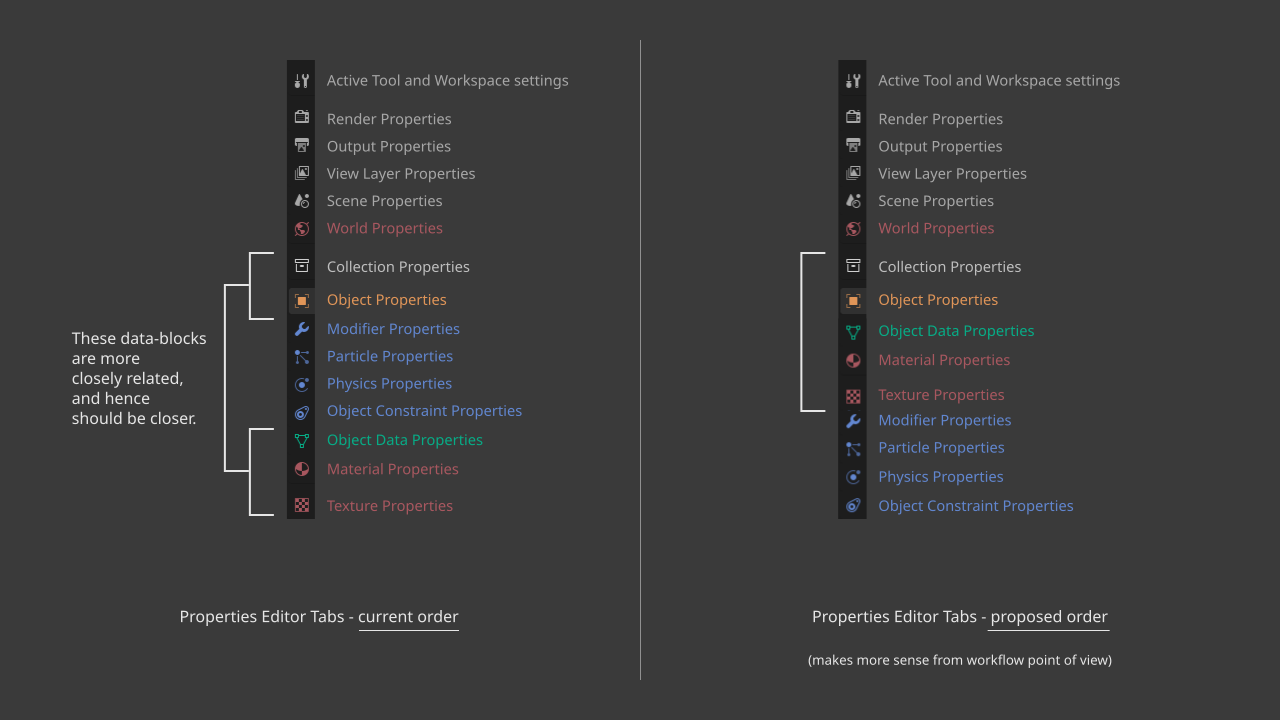
The sorting of properties was designed like this because Modifier, Particle Physics, and Constraints are
Object
level. They belong to the object, not the
Object Data
.
Textures are all the way down because they not only related to Object/Data stuff, but also modifiers, brushes, particle systems, and others.
1
l
lalitb.cgartistAuthor
Hi Pablo, I understand your argument from Blender’s internal design point of view. But I’m telling from a user’s point of view.
L
Lauloque
But it's the same from a user point of view, when the user knows how things work.
l
lalitb.cgartistAuthor
But look at it from the workflow point of view as well.
p
pablovazquez
It's not just about Blender's internal design. It's how relations work between objects and their data, something that is useful for all users.
As a user it's important to know that a modifier is object-level. That you can have 2 objects with the same
Object Data
(like mesh) but different modifiers on each one.
In your mockup, Modifiers is below Object Data, so it makes me think that the Modifier is attached to the Object Data, but it's not. You can swap the Object's Mesh datablock and the modifier will still work.
l
lalitb.cgartistAuthor
Okay Pablo. Got it. I’m fine with as it is.
And thanks for explaining in detail.
m
modormoder
Actually I see a slight contradiction. Yes, modifiers and materials now belong to the object. But it seems that now the development is moving so that the materials (or at least their shelves) belong to the mesh, and the modifiers are unified and continue to act on the mesh (and not the object data)
From this point of view, I would just draw a line on the difference between modifiers and constraints, but not change everything as in the example.
E
Epicrex
I disagree, the blocks are fine as is, think of it like this:
First we have the shell of the objects and their collection tabs
Then we shape and define this object as well as giving it special functions (with the mod, physics, constraints,... tabs)
Finally we texture that object (with the material and texture tab)
One would not first texture an object which is not already "shaped"

8 Comments
Actually there is a reason for the way these are listed.
The sorting of properties was designed like this because Modifier, Particle Physics, and Constraints are Object level. They belong to the object, not the Object Data .
Textures are all the way down because they not only related to Object/Data stuff, but also modifiers, brushes, particle systems, and others.
Hi Pablo, I understand your argument from Blender’s internal design point of view. But I’m telling from a user’s point of view.
But it's the same from a user point of view, when the user knows how things work.
But look at it from the workflow point of view as well.
It's not just about Blender's internal design. It's how relations work between objects and their data, something that is useful for all users.
As a user it's important to know that a modifier is object-level. That you can have 2 objects with the same Object Data (like mesh) but different modifiers on each one.
In your mockup, Modifiers is below Object Data, so it makes me think that the Modifier is attached to the Object Data, but it's not. You can swap the Object's Mesh datablock and the modifier will still work.
Okay Pablo. Got it. I’m fine with as it is.
And thanks for explaining in detail.
Actually I see a slight contradiction. Yes, modifiers and materials now belong to the object. But it seems that now the development is moving so that the materials (or at least their shelves) belong to the mesh, and the modifiers are unified and continue to act on the mesh (and not the object data)
From this point of view, I would just draw a line on the difference between modifiers and constraints, but not change everything as in the example.
I disagree, the blocks are fine as is, think of it like this:
First we have the shell of the objects and their collection tabs
Then we shape and define this object as well as giving it special functions (with the mod, physics, constraints,... tabs)
Finally we texture that object (with the material and texture tab)
One would not first texture an object which is not already "shaped"