
Cycles : Clustered Meshlets & Meshlets Streaming
Hi BF Community,
As our scenes grow increasingly complex whether through photogrammetry, heavy sculpting, or dense procedural environments we all face the same wall VRAM limits and viewport lag, dealing with millions of polygons currently means long BVH build times in Cycles and a struggling viewport
I would like to propose a high-level idea that is rapidly becoming a standard in the 3D industry: Clustered Meshlets (and meshlet streaming)
What is it, and how does it work?
Instead of treating a 3D model as one giant block of millions of triangles, the engine handles geometry in a much smarter way here is the simplified process
-
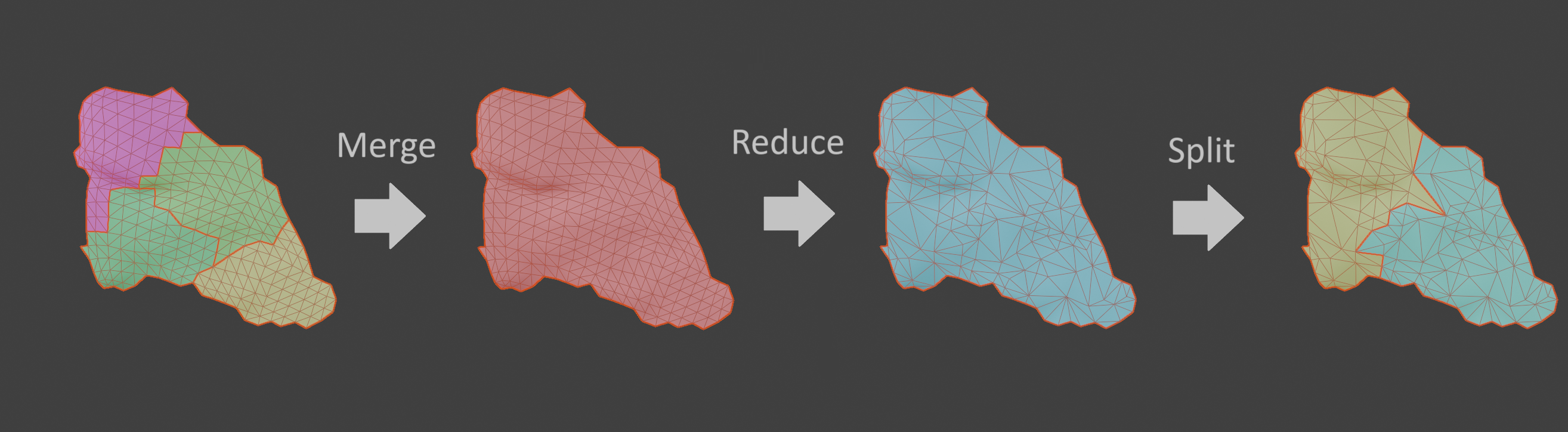
Partitioning: The high-density 3D model is chopped into tiny, self-contained patches called "meshlets" (usually around 64 to 128 triangles each)
-
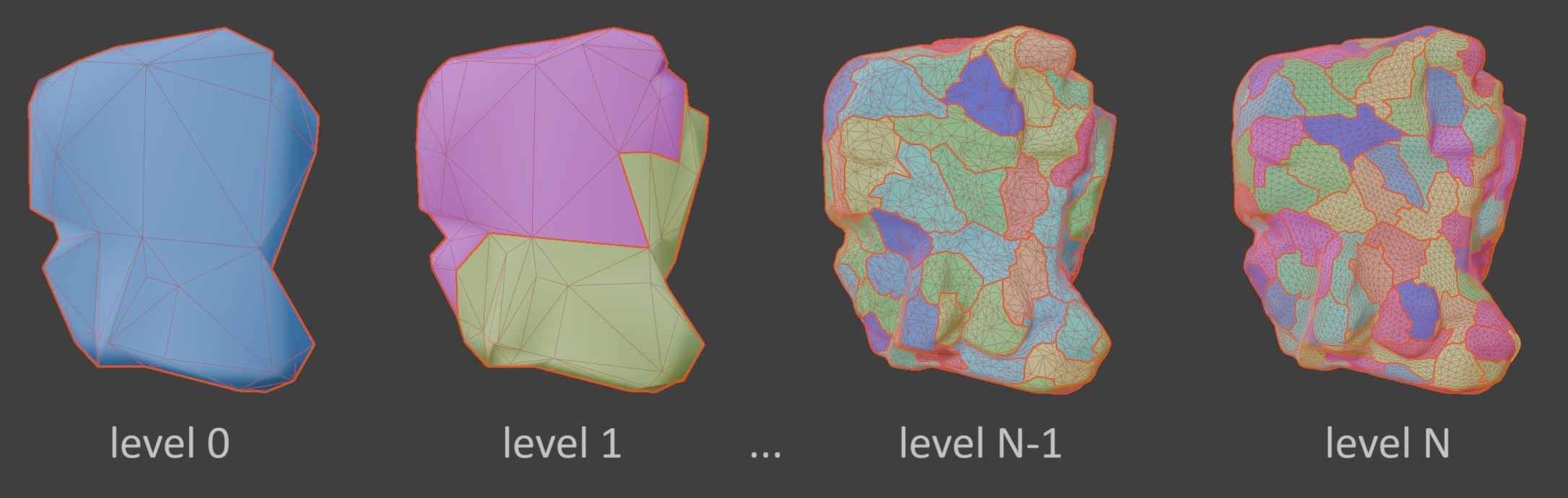
Clustering & Hierarchy: These small patches are grouped together, slightly simplified, and then regrouped again and again.This builds a sort of "family tree" (a Directed Acyclic Graph) of the geometry, ranging from the original high-resolution mesh down to a very low-resolution version
-
Smart Rendering & Streaming: When you navigate the viewport or hit render in Cycles, the engine looks at this tree It dynamically picks low-detail meshlets for areas that are far away, and high-detail meshlets for areas close to the camera It perfectly stitches them together on the fly, meaning zero visible seams or visual popping
Here is a great visual representation from the Simplygon documentation, showing how a mesh is progressively divided and clustered
Why would this be a game-changer for Blender?
-
End of VRAM Bottlenecks ? (Really Nop BUT !): By only keeping the necessary clusters in active memory, we could load and render incredibly dense scenes on consumer GPUs without running out of VRAM
-
Near-Instant Cycles Startup: Currently, Cycles has to build a Bounding Volume Hierarchy (BVH) for the entire geometry before it can even shoot the first ray with meshlets, Cycles would only need to process the active clusters, slashing pre-render waiting times
-
A Buttery-Smooth Viewport: EEVEE and the Workbench viewport could handle previously impossible polygon counts effortlessly
An Emerging Industry Standard
This technology is no longer just experimental; it is quickly becoming the golden standard for handling massive geometry:
- Simplygon recently integrated the Clustered Meshlet Optimizer , allowing engines to seamlessly stream geometry and manage continuous LODs based on camera distance
- Octane Render has also embraced meshlet technology in its path-tracing pipeline, proving that this architecture isn't just for real-time game engines (like Unreal's Nanite), but is incredibly beneficial for production path tracers too
Conclusion
While I understand this touches the very core of Blender's geometry and rendering architecture, looking into DAG-based meshlets and data streaming could future-proof Blender for the next decade of 3D creation !
0 Comments