
Optimize the review of extensions
Are there any official Blender personnel here?
As a printing industry practitioner, I have learned that Blender has been unable to directly output physical dimensions (such as centimeters) and DPI for nearly 19 years. Users must input pixels and then change DPI/PPI in Photoshop. This is not very friendly for printing, such as batch rendering 1000 images of 21cm * 29.7cm 300ppi.
So I saved up money to create an add-on for Blender, which allows Blender to set centimeters and dpi like C4D and Maya, and output images with accurate dpi when opened in Photoshop/Krita.
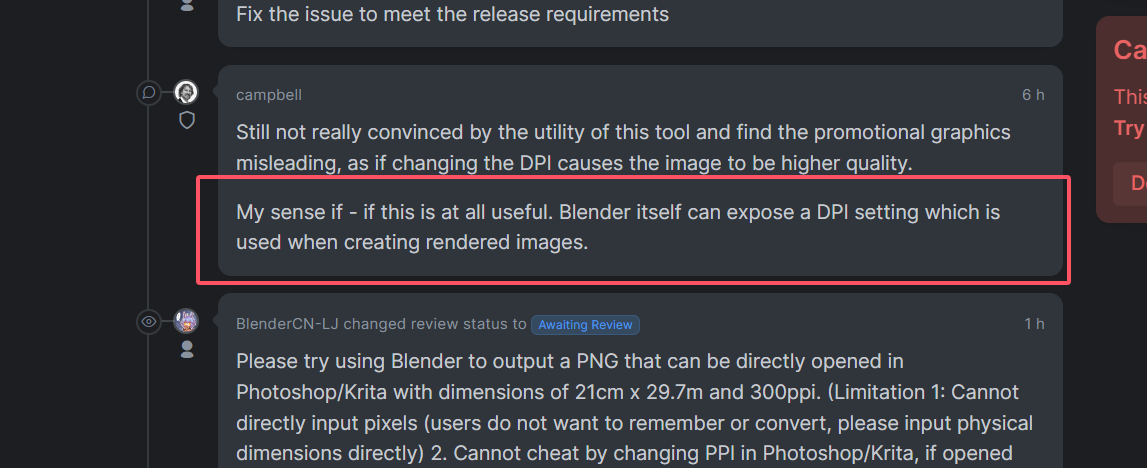
But after I submitted it to Blender extensions, the reviewer kept thinking that this thing was useless. It's hard for me to understand why even an AI written add-on with a pie menu and added commands could pass the review. I'm so frustrated
9 Comments
I think some of the discussion got lost in translation. From what I understand reading Campbell's comments, is that this seems to be something that Blender itself should have. This topic was brought up today and there seems to be agreement on adding support for it natively within Blender, so that's great news!
The Extensions platform is something very new that's exposing us to hundreds of add-ons that we didn't even know existed. Some of them are amazing ideas that really should be part of Blender, so I understand developers being hesitant about accepting an add-on that may workaround things when adding natively would be a lot easier (in this case it seems the code already supports setting DPI it's just that it was never exposed in the UI).
In a few years from now I imagine we are going to see a lot more features coming to Blender that were inspired from the most popular add-ons, because it is clear the community wants a feature (providing it is general enough for everyone I guess).
I'm sorry to hear about your frustation and I thank you for your support all these years.
Regarding low quality extensions in the platform, please feel free to report them or give honest reviews. Nobody wants the platform to be a pile of crappy add-ons, we are all hoping to have good quality content there, at the risk of sometimes being too strict. Anyone is welcome to help reviewing in the approval queue by the way.
At present, I mainly feel that it is too difficult to pass the review, which is painful for both reviewers and contributors. Perhaps we should find another way, such as user feedback?
It would be great if Blender itself could support DPI settings, as this issue has been around for almost 20 years blenderartists.org/t/blender-dpi-settings-pixel-size-calculator/348195
It does sound reasonable, but in the meantime the feature is "not there". The extension dev could still release it somewhere else like we have always done for addons, but wouldn't it be wise to simply approve the extension - at least until the in-house solution actually exists - so that the addon can be more accessible in the meantime ? And even then, unless the extension and the in-house solution are one-to-one identical, there wouldn't be much reason to disapprove the addon.
I also just went through the review process, and I also had an addon that I have developed and maintained for years - Right Mouse Navigation, Blender 2.8 - 4.2 - almost get rejected for being 'low effort' or 'below the minimum standard' for acceptance.
The reviewer mentioned that the addon function should be achievable by editing the user's keymap - which seems like it's true until you try it, and they were confused by what a certain variable did - there were three lines of code comments above the variable explaining exactly how it worked.
Then they suggested generalizing the function of the addon to be either a keymap editor or to add a secondary function to any key in Blender.
I pointed out that it was not possible to do via keymap editing, even though it seems like it should be, and explained how the code worked.
Eventually the reviewer did attempt to implement the behavior using their method, realized it didn't work and approved the addon, but at that point I was already pretty demoralized.
I know it doesn't do very much, but it's very helpful to my workflow, and I know a lot of others have said the same. If there is a minimum standard for functionality then it should be posted online, somewhere in the docs so that people can read it before they submit their extension.
And, to say that a feature could be implemented natively is not a reason to reject an addon that is functional today. Any feature could be implemented natively, but some will be rejected at the feature or pull request stage.
We could have native support for texture layers, extra noise types, one-click baking, horizontal toolbars, CAD editing, code editing etc. but either no-one is working on them, or they have been announced as 'coming at some point'.
And, if an addon offers functionality that is so good that the devs feel inspired to integrate it, then do, it's all GPL anyway!
This can be said of countless addons.
The whole point of addons is to give artists a function that is not native, isn't it?
Certainly it's great when an addon becomes native code, but telling an addon contributor "this doesnt look useful" (which it is), or "Not approving, because should be native function" (so - wait, is it useful or not?) is quite a different thing.
I mean - someone thought THIS was useful enough to approve it...
extensions.blender.org/add-ons/add-positive-cube/
My suggestions are:
(Perhaps an initial rating can be set? This way, even tools with lower initial scores can receive higher ratings based on their popularity)
Meanwhile, the auditing of extensions is too strict and slow. This means that plugins written by AI or simple plugins with Pie menu+instructions are easier to pass the review process, and the number of developers willing to develop Blender for free is already small. I think this creates obstacles that go against open source
I once donated Blender Corporate Bronze for nearly 18 months, but I felt that some of the actual production items seemed to be of no interest to anyone, so I used the funds to develop Blender add ons, but obviously, this was very frustrating. I should consider whether it's worth continuing to spend $100000 annually on Blender development.