
Fix booleans - coplanar faces
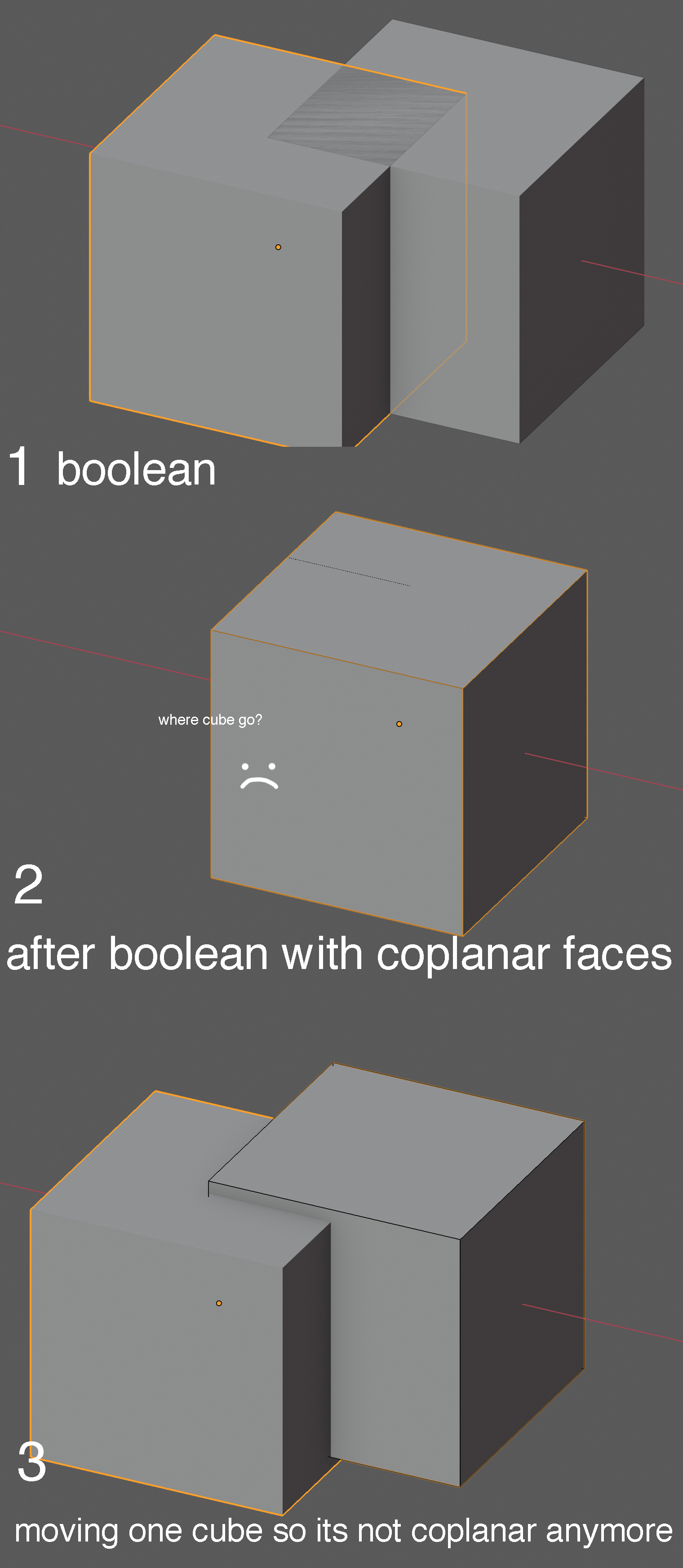
It would be immensly useful to be able to perform booleans on objects with coplanar / overlapping faces. Blender flips out when you try this. As far as i know on most 3D programs (sketchup / solidworks / 3ds max) this is possible.
14 Comments
I applaud you for putting a priority on the problems with booleans. For whatever it's worth, I'm upvoting this because I think it's the foremost problem holding Blender back from wider use in CAD and Architecture.
I teach 3D Design using Blender and constantly run into the issue that when CAD objects are designed correctly they WILL have coplanar faces.
this comes up all the time and it's being worked on. devtalk.blender.org/search
* @testure * And there's already work on this in the 2.81 master (the new Constrained Delaunay Triangulation, whatever that is!)
* @Josephbburg * great news
still not working
I had similar problem when writing a slicer plugin for Blender. The way around it was to move one object by 0.00001, perform booleans, select all vertices that are 0.00001 off and moving them down, subsequently removing doubles.
This approach may not be suitable for you if you don't script.
Just a side note, I also did accuracy testing on simple meshes and the most extreme vertex was off by 0.19 mm on a 10 cm object, which led me to abandon booleans altogether. Instead I am on a path of poor man booleans, which basically means that I (my code) must analyze the mesh myself instead of Blender.
Great...thx
Should this then be labeled 'in development' ?
* @Jelleeey * yep.
developer.blender.org/T67744
Howard Trickey is currently working on new boolean , but he is spare time developer so it might take w while to make it to master.
commit from newboolean branch - " A coplanar intersect case works."
The math behind Boolean is extremely difficult. I believe that AutoCAD has a 100% perfect Boolean that supports real Sphere, Torus, Cone, etc. I mean it's possible in the very future Blender (maybe Blender 3.0), its a proposal.
* @mandadream3d * it's only difficult if you're trying to be mathematically precise (which is going to be impossible in blender anyway given floating point constraints). If you're only interested in getting the result a user intended it's not any more difficult that other computational geometry (aside from a bit of additional recursion). Howard has a solution he's working toward and it's not "for the far future".
This is a real issue :(