
Option to increase the precision of volume density in Cycles
Edit: Improved clarity.
Description
Using Cycles, in order to accurately simulate volumetric atmosheric lighting, you must use an object with a volume node connected to the volume material output. Note: Mist pass does not interact with light, so is not considered an accurate option.
Currently it is not possible to simulate realistic atmospheric density because the value of the density literally does not go sufficiently low .

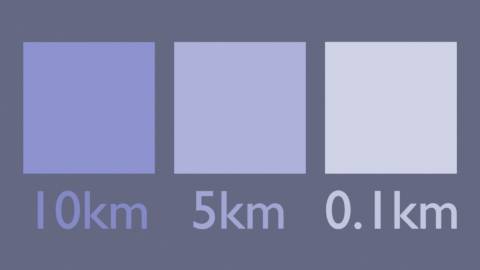
Ideally it would be possible to smoothly animate from 0 density up to full density even for the object 10km away, and consider right now the next lower value is 0. To make that possible it would likely require a doubling of the precision.
Example usecases
- A single shot travelling through a large scene, including close-ups, without trickery.
- A large ship, as seen by a human character, coming in from far away to land next to the character.
Should be an option
I'm suggesting this as an option per volume node because the extra data for the precision would otherwise impact performance of scenes that contain a large amount of small volumes that do not need it.
4 Comments
Use simple spherical gradient from camera. Or mist pass. IRL fog do not have same density all over the world. Fog is layered, it`s density lows somwhere. So do the same.
* @ Vyacheslav * What do you mean by spherical gradient?
And sometimes, even though you've been using Blender for many years, you discover a feature that has always been there. I'm in disbelief that mist passes exist.
Edit: I've been messing with it a bit, and something really stands out regarding mist passes: light doesn't bounce off the mist, which isn't realistic. Using a volume object, atmospheric fog creates environment light, so using mist passes is sort of solving one problem but creating another.
* @kalciferkandari * Okay, if you need volumetric light, use volumetrics. And apply any 3-dimentional function, what you want. Gradients, spheres, clouds… {attachment 2020-04-18_16-26-01mp4} {attachment 2020-04-18_16-34-50mp4}
No need for limited additional function.
* @ Vyacheslav * There is some misunderstanding here, so I have improved the clarity of the post.
The problem is that the current volume density value literally does not go sufficiently low to simulate the density of the atmosphere. I understand the atmosphere isn't perfectly uniform, but that is not relevant to the proposal.