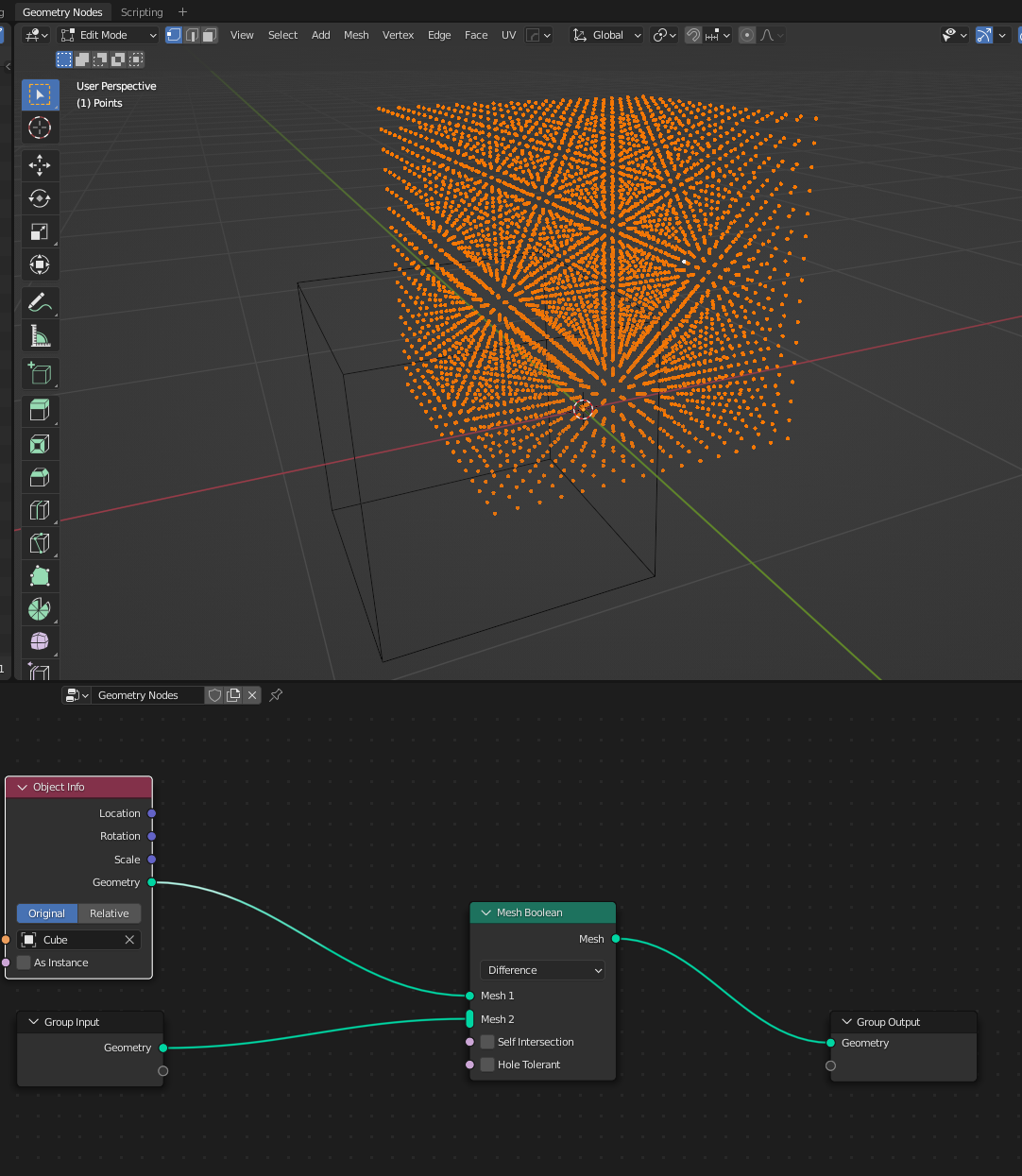
We already have a "boolean for points" - it's the raycast node
2
m
modormoder
I don't think you understand how this sounds. Node raycast doesn't solve this problem in principle. At a minimum, you don't know if your point is inside or outside. You only know that you are from the nearest normal.
V
Vik
"My" solution solves it about as well as boolean solves its own issue; it works perfectly fine in a properly modeled mesh with good normals and both it and boolean will break if your mesh has bad topology or bad normals. In a proper mesh, if the first face that a completely random ray from a point hits is looking away from the point, then the point is inside; if it hits no face, or the face is looking towards the point, then it is outside. This doesn't hold true only for meshes with holes or bad normals or whatever issues (which, again, also break boolean). If your mesh is bad, then fix it.
It doesn't need to be any more complex than this. Explain what your better solution would be.

3 Comments
We already have a "boolean for points" - it's the raycast node
I don't think you understand how this sounds. Node raycast doesn't solve this problem in principle. At a minimum, you don't know if your point is inside or outside. You only know that you are from the nearest normal.
"My" solution solves it about as well as boolean solves its own issue; it works perfectly fine in a properly modeled mesh with good normals and both it and boolean will break if your mesh has bad topology or bad normals. In a proper mesh, if the first face that a completely random ray from a point hits is looking away from the point, then the point is inside; if it hits no face, or the face is looking towards the point, then it is outside. This doesn't hold true only for meshes with holes or bad normals or whatever issues (which, again, also break boolean). If your mesh is bad, then fix it.
It doesn't need to be any more complex than this. Explain what your better solution would be.