
Texture Array Slice Indexing / DDS support
This idea proposes adding support for sampling the slices from a DDS texture array or in Blender’s Shader Nodes, using an attribute, value or input to drive that slice index. It enables clean, per-face or per-object texture variation using a single material—without tiled atlases, UV hacks, or mipmap bleed artifacts.
Blender currently supports texture atlases, *.dds and UDIM, adding support for texture Arrays, would be be a huge help to artists working with decals, terrain tiles, and efficient real-time rendering workflows.
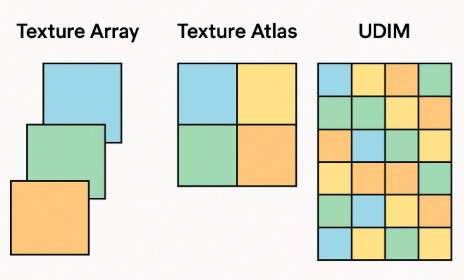
Why it's a good idea:
Current atlas-based setups require re-authoring textures for even small changes, which is time-consuming and hard to maintain. Adding more tiles increases texture size, introduces mipmap artifacts, and often requires padding to avoid bleed—wasting space. A texture array offers a cleaner, more scalable solution with predictable performance and simpler maintenance.
I envision this feature listed in the texture node options:
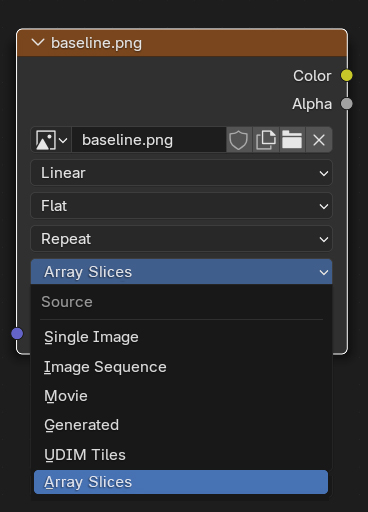 There would be two ways to access the array slices once the image source "Array" has been selected. Either through a pre saved *.dds file with texture array slices or a folder/series of textures with a naming structure similar to UDIM.
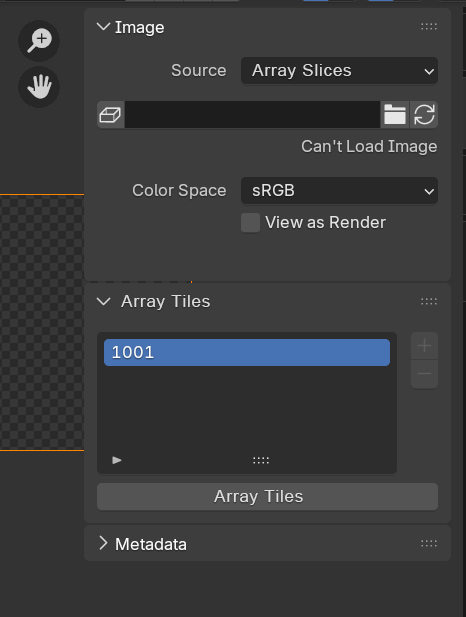
The array layers could be seen, generated and edited in the texture editor, also similar to UDIM.
There would be two ways to access the array slices once the image source "Array" has been selected. Either through a pre saved *.dds file with texture array slices or a folder/series of textures with a naming structure similar to UDIM.
The array layers could be seen, generated and edited in the texture editor, also similar to UDIM.
This feature would position Blender as a more capable real-time rendering tool for storyboarding, presentation, and interactive experiences. It also improves compatibility with real-time asset pipelines like Unity and Unreal, and opens the door to GPU instancing and batching workflows.
Texture array slices, as supported in .dds files, are widely used in real-time engines. Blender already imports .dds; this would extend that support to include array-based sampling, making better use of an existing format.
This provides a clean, scalable alternative to texture atlases:
-
No UV hacks or padding
-
Eliminates mipmap bleed
-
Supports per-object variation in a single material
-
More efficient memory use and rendering
It’s cross-platform, GPU-standard, and opt-in, with minimal disruption to existing systems.
I would be eager to develop a working proof of concept, with full documentation and a test build.
0 Comments